
SpaceX and xAI may be exploring orbital AI data centers powered by solar energy. If realized, this space-based infrastructure could redefine the economics of artificial intelligence.
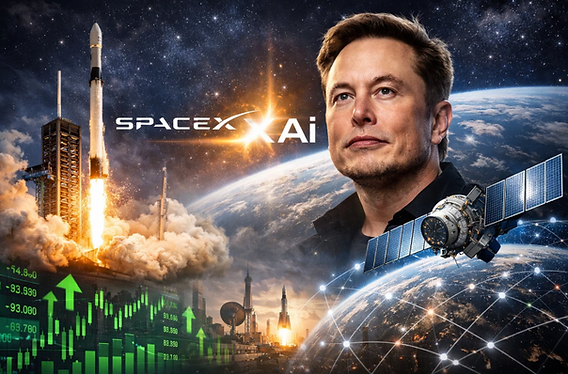
A profound shift may be unfolding at the intersection of space infrastructure and artificial intelligence economics.
Reports circulating across technology and venture capital circles suggest that SpaceX and xAI are exploring the possibility of integrating their capabilities into a unified technological ecosystem … an alliance that some analysts believe could eventually command valuations approaching $1 trillion if fully realized.
This would not simply be a corporate merger.
It would represent the convergence of two of the most strategically important infrastructures of the 21st century: orbital logistics and artificial intelligence computation.
The logic is straightforward but extraordinary.
Artificial intelligence is entering an era where compute power has become the new industrial resource. Training frontier AI models now requires vast data centers consuming gigawatts of electricity, placing enormous pressure on terrestrial energy grids and cooling infrastructure.
The long-term vision being discussed in advanced research circles is the construction of orbital data centers powered by continuous solar energy, by integrating launch capability from SpaceX with the AI model development ambitions of xAI.
Unlike Earth-based facilities, orbital systems could theoretically harvest near-constant solar radiation, dramatically increasing energy availability while eliminating many of the land, cooling, and grid constraints that limit conventional AI infrastructure.
In simple terms:
Instead of building the future of artificial intelligence on Earth, the idea is to build part of its computational backbone in space.
Such infrastructure would fundamentally alter the economics of AI computing.
Today, hyperscale data centers must compete for land, water, cooling capacity, and electrical supply.
Orbital facilities could operate as permanent solar-powered compute platforms, transmitting processed data back to Earth while operating on energy that is effectively unlimited.
The implications extend far beyond technology.
If realised at scale, a vertically integrated system combining launch capability, satellite networks, orbital infrastructure, and AI model development would represent one of the most ambitious industrial architectures ever attempted.
It would mean that the next phase of the digital economy may not just be built in silicon valleys or cloud regions.
It may be built in orbit.
And if such an ecosystem were ever consolidated under a single technological umbrella, the resulting entity would not merely be another tech company.
It would be a planetary-scale infrastructure operator for the age of artificial intelligence.
© The Marketing Maven